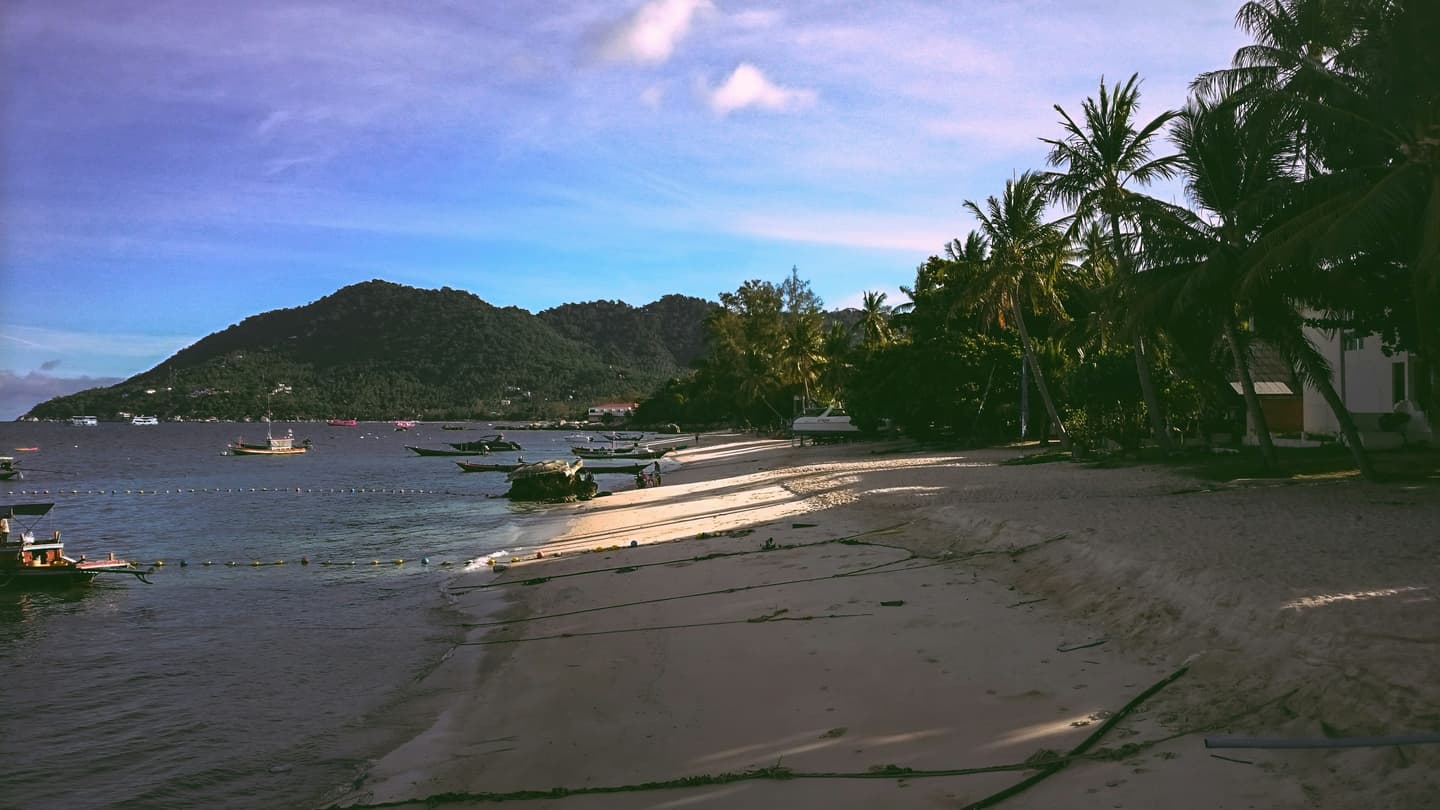
 City postcard
Ko Tao
Thailand's dive capital — a tiny Gulf island packed with world-class reefs, sandy beaches, and a legendary party scene.
Thailand's dive capital — a tiny Gulf island packed with world-class reefs, sandy beaches, and a legendary party scene.
Ko Tao (Turtle Island) is the smallest of the three main Gulf of Thailand islands, yet it punches far above its weight. It is one of the world's most popular places to earn a PADI open-water certification, with over 50 dive sites ringing the island. Above the water, visitors find white-sand beaches, jungle hiking trails, a buzzing backpacker strip, and a growing café scene that attracts digital nomads. Despite its compact size, Ko Tao rewards explorers who venture beyond Sairee Beach with secluded bays and dramatic viewpoints.
City postcardThailand's dive capital — a tiny Gulf island packed with world-class reefs, sandy beaches, and a legendary party scene.
A signature stop locals and returning travelers point to in Ko Tao.
A signature stop locals and returning travelers point to in Ko Tao.
A signature stop locals and returning travelers point to in Ko Tao.
A signature stop locals and returning travelers point to in Ko Tao.
A signature stop locals and returning travelers point to in Ko Tao.
A signature stop locals and returning travelers point to in Ko Tao.
A signature stop locals and returning travelers point to in Ko Tao.
A signature stop locals and returning travelers point to in Ko Tao.
A pocket of Ko Tao with its own temperament — worth a deliberate detour when you're in the area.
A pocket of Ko Tao with its own temperament — worth a deliberate detour when you're in the area.
A pocket of Ko Tao with its own temperament — worth a deliberate detour when you're in the area.
A pocket of Ko Tao with its own temperament — worth a deliberate detour when you're in the area.
Wanderlust Pro
Pro members see insider tips for Ko Tao: a short list of restaurants, cafés and sights, picked by AI as local suggestions to double-check before you go.
The quick answers travelers want before they commit to flights, neighborhoods, and how long to stay.
There is no airport on Ko Tao — the only way to arrive is by boat. The closest airports are Koh Samui (USM), Surat Thani (URT), and Chumphon (CJM). The fastest route is to fly into Koh Samui (Bangkok Airways operates flights roughly every 30 minutes from Bangkok between 06:00–22:00), then take a Lomprayah or Songserm high-speed catamaran to Ko Tao — the sea leg takes about 1 hour 45 minutes. All ferries dock at Mae Haad pier. The most popular budget option from Bangkok is a combined bus + ferry ticket: Lomprayah and Boonsiri both operate air-conditioned coaches from central Bangkok (departing around 06:00 and 21:00 from Khao San Road) that connect directly to their Chumphon piers, followed by a ~1 hr 45 min ferry to Ko Tao. The overnight train from Bangkok's Krungthep Apiwat station to Chumphon is a classic option — second-class sleeper berths are available, and the ferry company offers a free transfer from the station to the pier; the morning Lomprayah ferry departs Chumphon at 07:00. A slower but scenic night boat from Surat Thani departs at 22:00 and is a good budget option for travellers arriving from Phuket, Krabi, or overland from Malaysia.
Ko Tao has no public buses or metro system. The most flexible way to explore the island is by renting a scooter — expect to pay roughly $6–$10 USD per day (or $120–$200 USD per month). Roads on the west coast and to main beaches are sealed, but some tracks to remote east-coast bays remain steep and rough, so exercise caution. Motorbike taxis are available islandwide for short hops at around $2–$5 USD per ride. Taxi trucks (songthaews) connect the main villages; a one-way taxi from Mae Haad to Sairee runs around 400 THB, and Mae Haad to Tanote Bay or Freedom Beach costs around 550 THB. For coastal spots, longtail boats are a fun alternative — a return trip from Mae Haad to Koh Nang Yuan costs approximately 600 THB, and to Ao Leuk around 800 THB. If you're staying in Sairee or Mae Haad and not planning to venture far, the island is walkable.
Ko Tao is broadly a year-round destination, but the dry season from December through April offers the most reliable conditions — sunny skies, calm seas, lower humidity, and diving visibility regularly hitting 20–30 metres. March and April are sweet spots: whale sharks frequent Chumphon Pinnacle and Sail Rock, seas are at their flattest, and dive schools run all sites without weather cancellations. April also brings Songkran festivities. January and February see peak tourist numbers and higher prices, especially around Christmas/New Year. For a sweet balance of good weather and thinner crowds, June is ideal — the island quiets down after the high season while seas remain calm. September and October are worth considering for experienced divers: whale shark sightings remain common and conditions stay very good, even as visitor numbers ease. Avoid November, when the monsoon typically arrives — persistent rain, rough seas, and ferry cancellations are all possible, and many businesses close for the low season.
Arrive by ferry at Mae Haad pier. Check in to your accommodation in Sairee or Mae Haad, then stroll the pier area and grab breakfast at a beachfront café.
Walk or take a taxi along Sairee Beach — at 1.7 km it's the island's longest stretch of white sand. Browse dive schools and sign up for an Open Water or fun dive course starting tomorrow.
Head back to Mae Haad for dinner at one of the seafood restaurants near the pier, then explore Sairee's bar strip — Choppers and Maya Beach Club are classic first-night stops.
Join your first dive or guided snorkel tour. Beginners can complete pool and theory sessions; certified divers should aim for Chumphon Pinnacle or White Rock for abundant marine life.
Take a longtail taxi boat from northern Sairee to the iconic Koh Nang Yuan — a trio of islets connected by a sandbar (entry fee ~250 THB). Hike to the summit viewpoint for panoramic Gulf views and snorkel the reef below.
Return to Sairee for sunset cocktails, then join the famous Koh Tao Pub Crawl — billed as the largest in Asia — for a full night of island socialising.
Rent a scooter (or hire a taxi) and head to the quieter east coast. Visit Tanote Bay for crystal-clear snorkelling among boulders, then continue to Hin Wong Bay for dramatic scenery.
Hike up to John-Suwan Rock Viewpoint (near Chalok Ban Kao) for the best panoramic view on the island. Cool off at Freedom Beach (Sai Daeng) on the south coast — one of Ko Tao's most secluded stretches of sand.
Head to Chalok Ban Kao village for a relaxed final dinner, then catch the sunset from a hillside bar before heading back to prepare for your ferry departure.
Real coworking spaces, laptop-friendly cafés, and libraries mapped near the center of the city — the closest, best-rated desks first.
No coworking-ready spots surfaced for this city yet.
Pick a different category or check back once we’ve indexed more desks for this city.
Ask for cafés, quiet neighborhoods, date-night spots, or a first 48-hour plan.
Mention calls, Wi-Fi needs, or how much of the day has to stay laptop-friendly.
Get faster answers on where to stay, when to move neighborhoods, and what to skip.
There aren’t any, yet!
Block off the weeks you're free. Wanderlust turns this dossier — flights, lodging, neighborhoods, timing — into a single draft itinerary in about ninety seconds.
Wanderlust Pro
Insider tips for Ko Tao, unlimited AI-built itineraries, and travel companions you can invite to plan a trip together. From $5.00/month, billed annually.
Wanderlust Pro
Pro members see insider tips for Ko Tao: a short list of restaurants, cafés and sights, picked by AI as local suggestions to double-check before you go.