City guide · Updated June 2026
EuropeItaly44.5° · 11.3°
Bologna,Italy.
Italy's unrivaled food capital wrapped in medieval porticoes, red-brick towers, and irresistible local energy.
Bologna · IT
BolognaItaly
★
Guglielmo Marconi Airport (BLQ)NEAREST AIRPORT
Population
399,640
Total residents
Global rank
#352
Wanderlust index
Best time
April to June and September to…
Peak window
Time zone
Europe/Rome
Local time
Currency
EUR
Money in use
Language
Italian
Spoken locally
01 · Overview
About Bologna
Italy's unrivaled food capital wrapped in medieval porticoes, red-brick towers, and irresistible local energy.
Bologna captivates with its stunning medieval architecture, centuries-old UNESCO-listed porticoes, and the most celebrated food scene in Italy. Known as "La Grassa" for its rich gastronomic traditions, the city serves up authentic tagliatelle al ragù, tortellini, mortadella, and a wine culture as deep as its history. Home to one of the world's oldest universities, Bologna balances intellectual energy with a lively aperitivo scene and a refreshingly authentic local atmosphere that sets it apart from Italy's more tourist-saturated cities. With high quality-of-life indicators and a practical, walkable layout, it ranks among the most livable cities in the country.
02 · Wanderlust scorecard
How Bologna scores
Ratings run 0 to 5 unless marked. They come from our AI-assisted research and are refreshed on a rolling basis.
2.5
/ 5
Cost of living
Affordability, 0–5. Higher means cheaper.
4.5
/ 5
Leisure
Leisure rating, 0–5.
20
Mbps
Connectivity
Median internet speed.
4.5
/ 5
Safety
Safety rating, 0–5. Higher is safer.
4
/ 5
Overall livability
Overall rating, 0–5.
2.5
/ 5
Air quality
Air-quality rating, 0–5. Higher is cleaner.
7.3
index
Index score
Wanderlust ranking, 0–10: overall, safety, internet, cost, leisure and air quality, weighted.
03 · Weather & when to go
Best time to visit Bologna
Current weather and the forecast, and the months our research rates best for a visit.
Month by month
Best months Either side Other months
Jan
Feb
Mar
Apr
May
Jun
Jul
Aug
Sep
Oct
Nov
Dec
Sweet spot: April to June and September to October offer mild weather, pleasant sightseeing conditions, and fewer crowds than peak summer. Note that trade-fair season (March–May and September–December) can push hotel prices significantly higher..
More cities for these months: Where to go in April · Where to go in May · Where to go in June · Where to go in September · Where to go in October
04 · Things to do
Things to do in Bologna
Top sights from our AI-assisted research, and other places we have photos of.
Top sight
Top sight
Basilica di San Petronio
Top sight
Top sight
Porticoes of Bologna (UNESCO World Heritage)
Top sight
Top sight
Sanctuary of the Madonna di San Luca
Top sight
Top sight
MAMbo – Museum of Modern Art
Top sight
Top sight
Mercato di Mezzo & Mercato delle Erbe
05 · Monthly cost of living
Cost of living in Bologna
Estimated monthly totals in USD from our AI-assisted research, one per profile. Treat them as a starting point for a budget, not a quote.
$2,100
estimated monthly spend · USDProfileExpat
Price references — vs. profile benchmarks
Nomadmonthly spend · USD
$1,600
-24%
Expatmonthly spend · USD
$2,100
baseline
Familymonthly spend · USD
$5,244.8
+150%
Localmonthly spend · USD
$1,385.7
-34%
Median fiber speeddownload · Mbps
20
Mbps
06 · Neighborhoods
Where to stay in Bologna
Neighborhoods our AI-assisted research lists as popular with visitors.
Centro Storico
Santo Stefano
Zona Universitaria (Via Zamboni)
Quadrilatero
07 · Stay & eat
Places to stay and eat in Bologna
Hotels, cafés and restaurants Wanderlust members have added for Bologna.
Places to eat
01
Malì Cafè, Via Carlo Jussi, San Lazzaro, Metropolitan City of Bologna, Italy
08 · Insider tips
Sights and neighbourhoods, with a tip each.
Practical tips on places from this Bologna guide, written with AI. One is free; Pro members see the rest. Double-check details before you go.
Insider tips · Wanderlust Pro
Practical tips on the sights and neighbourhoods in this Bolognaguide — when to go, what most visitors miss. Written with AI about the guide's own places; double-check details before you go. Pro members see every tip.
09 · Practical notes
Practical information for Bologna
The essentials from this guide's data, in one place.
01
Getting there
- Nearest airport — Guglielmo Marconi Airport (BLQ)
02
Money
- Currency — EUR
- Affordability — 2.5/5 on the Wanderlust index (higher is cheaper)
03
Internet
- Median speed — 20 Mbps
- Internet score — 2.7/5
04
Safety
- Safety score — 4.5/5 from our AI-assisted research
05
Language
- Primary language — Italian
06
Timing
- Best window — April to June and September to October offer mild weather, pleasant sightseeing conditions, and fewer crowds than peak summer. Note that trade-fair season (March–May and September–December) can push hotel prices significantly higher.
- Time zone — Europe/Rome
Questions
Frequently asked, plainly answered.
The quick answers travelers want before they commit to flights, neighborhoods, and how long to stay.
Is Bologna safe for travelers?+
Bologna has a safety rating of 4.5 out of 5.
What is the best time to visit Bologna?+
The best time to visit Bologna is April to June and September to October offer mild weather, pleasant sightseeing conditions, and fewer crowds than peak summer. Note that trade-fair season (March–May and September–December) can push hotel prices significantly higher..
How expensive is Bologna?+
Bologna has an affordability score of 2.5 out of 5, where 5 is most affordable.
What is the internet speed in Bologna?+
Bologna has an average internet speed of 20 Mbps.
What currency does Bologna use?+
The currency used in Bologna is EUR.
What language is spoken in Bologna?+
The primary language spoken in Bologna is Italian.
Researched city guide
Getting there, getting around and when to go
Written with AI-assisted web research. Where we have sources, they are listed under each part.
What works
- World-class food scene — authentic ragù, tortellini, mortadella, and Parmigiano Reggiano at their source
- UNESCO-listed porticoes make it one of Italy's most walkable and rain-friendly cities
- Far fewer tourists than Rome, Florence, or Venice — genuinely local atmosphere
- Excellent rail connectivity: Florence in ~45 min, Rome in ~2 hrs, Milan in ~1 hr
- Vibrant student-driven nightlife and aperitivo culture
- High quality of life and one of Italy's most livable cities
What to weigh
- Air quality can be poor, especially in winter, due to Po Valley geography and traffic
- Trade-fair periods cause hotel price spikes and availability crunches
- Summers are hot and humid; some local businesses close in August
- English is less prevalent outside tourist areas than in Rome or Florence
- Limited world-famous 'marquee' monuments compared to other Italian cities
Getting in
How to arrive
Bologna Guglielmo Marconi Airport (BLQ) sits approximately 10 km from the city centre. The fastest link is the Marconi Express monorail, covering the route to Bologna Centrale railway station in just 7 minutes. A single ticket costs €12.80 and a return €23.30 (valid for 30 days); tickets include 75 minutes of onward travel on Tper urban bus lines. Pay contactless directly at the gate with any Mastercard, Visa, or NFC-enabled device — no pre-purchase needed. The service runs 5:40 AM to midnight, 365 days a year, with up to 8 departures per hour during peak times. A cheaper alternative from May 2025 is the new 'Q' bus connection (€2.30 urban fare), running between the airport, Maggiore Hospital, and Bologna Centrale. The direct electric bus 'Marconi Express 949' offers a no-transfer option to Piazza Malpighi in the city centre for €9.80. For those arriving by rail from other Italian cities, Bologna Centrale is a primary high-speed hub: Florence is roughly 45 minutes away and Rome around 2 hours.
Getting around
Moving through the city
Bologna is best explored on foot — its UNESCO-listed porticoes naturally guide you through the historic centre, and you can cross nearly the entire old city without opening an umbrella in the rain. Cycling is an excellent secondary option thanks to flat streets and an expanding bike-lane network; e-bike tours are a popular way to reach outlying spots like the Sanctuary of San Luca. The city's Tper bus network links the train station, residential neighbourhoods, and major attractions efficiently; urban bus fares are €2.30, integrated with Marconi Express tickets for 75 minutes after validation. Tickets can be purchased via the Roger or Muver apps, contactless at validators, or at Tper ticket offices. Taxis and Uber (regulated at taxi rates in Italy) are available for longer trips or early-morning airport runs.
When to go
Timing your trip
The sweet spots are the shoulder seasons: April through June and September through October. Spring brings mild temperatures ideal for walking the porticoes and climbing the Asinelli Tower, while autumn offers golden light over the red-brick roofscape and the start of the new academic year, when the city hums with returning students. Summer (July–August) can be hot and humid, with some restaurants and shops taking August breaks, though the city remains lively thanks to its local population. Winter is the quietest period but carries its own charm — fog-draped piazzas, hearty ragù, and uncrowded museums. One important caveat: Bologna hosts major trade fairs throughout the year, particularly March to May and September to December, during which hotel prices can more than double and individual reservations become harder to secure. Book well ahead if your dates overlap with Bolognese Fiere events.
Sources
Plan your trip
3 days in Bologna: a sample itinerary
A ready-made starting point. Make it your own — clone it into an editable journey and reshape every stop.
Day 01
Day 1 – The Historic Heart
Morning
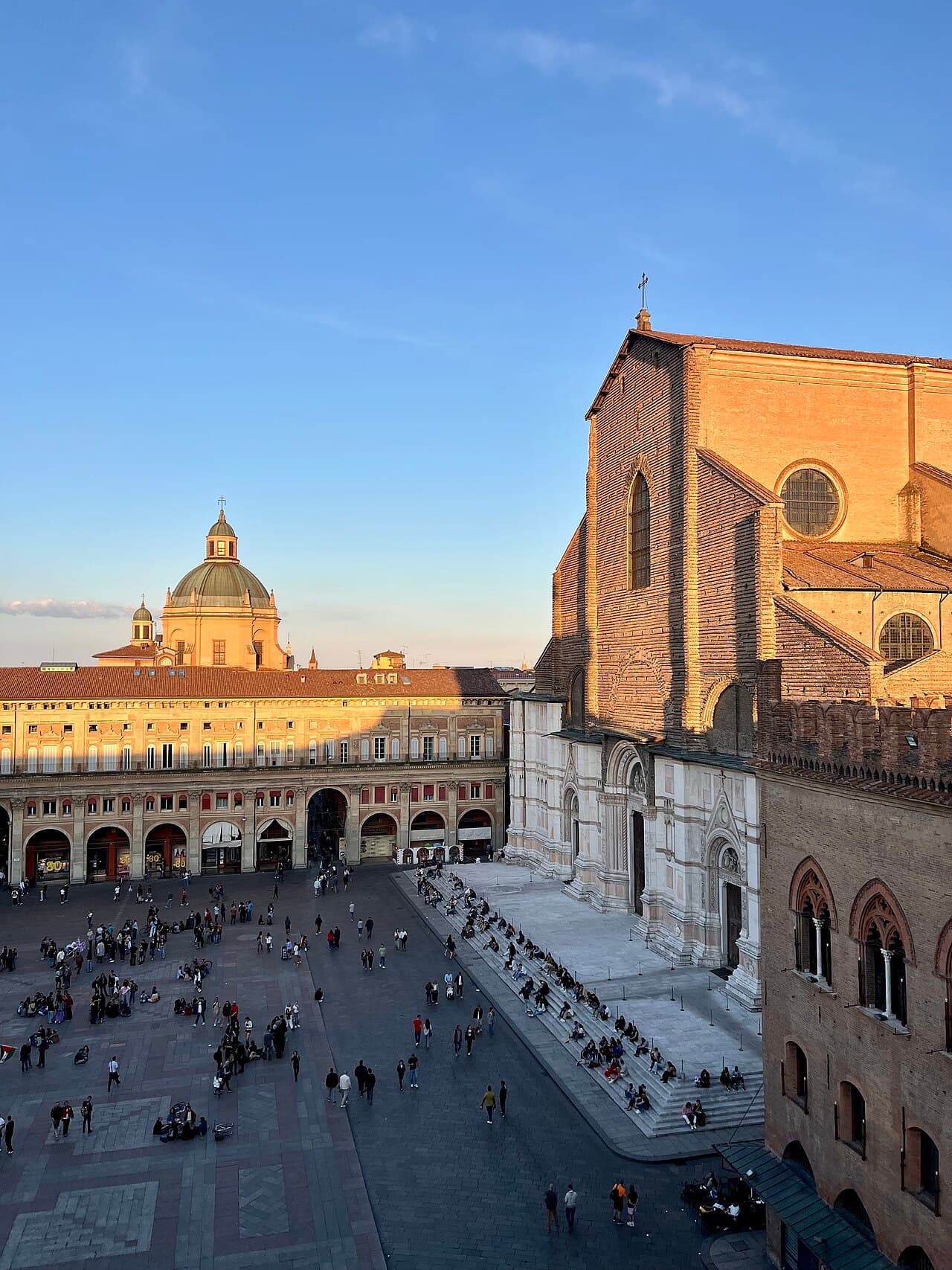
Start at Piazza Maggiore, Bologna's vast medieval heart, ringed by the Palazzo d'Accursio, Palazzo del Podestà, and the imposing Basilica di San Petronio — the sixth-largest church in Europe. Climb to the basilica's rooftop terrace for sweeping views of the city and the surrounding Apennine hills.
Afternoon
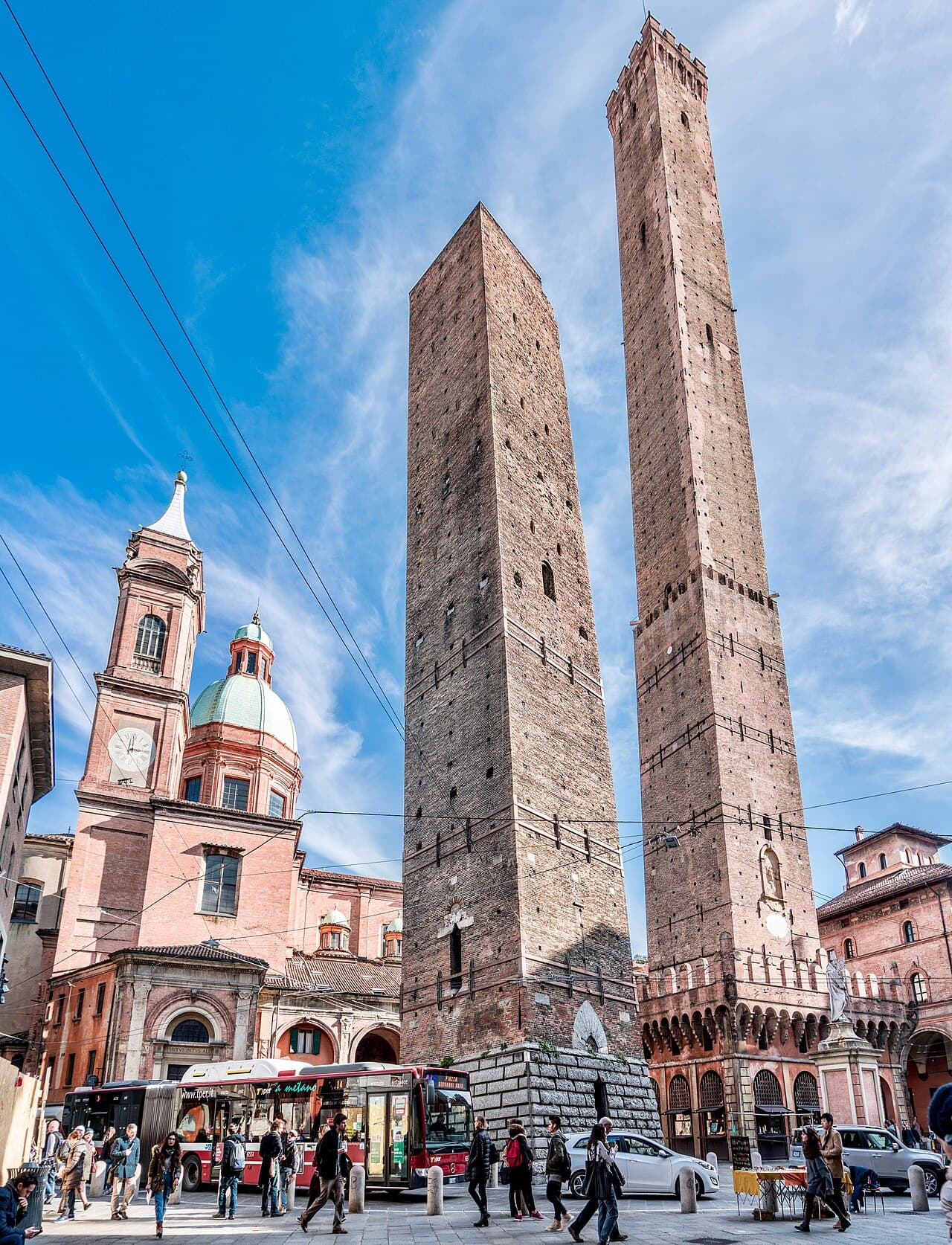
Wander into the Quadrilatero neighbourhood for lunch amid the covered market stalls of Mercato di Mezzo — try a tigelle sandwich with mortadella or squacquerone. Head next to the Due Torri (Asinelli and Garisenda towers) and, if legs allow, climb the Asinelli for a panoramic reward.
Evening
Join locals under the porticoes of Via Indipendenza or Via Zamboni for aperitivo — a spritz or glass of Pignoletto with complimentary snacks. Dinner at a neighbourhood osteria: tagliatelle al ragù is non-negotiable.
Day 02
Day 2 – Art, Academia & San Luca
Morning
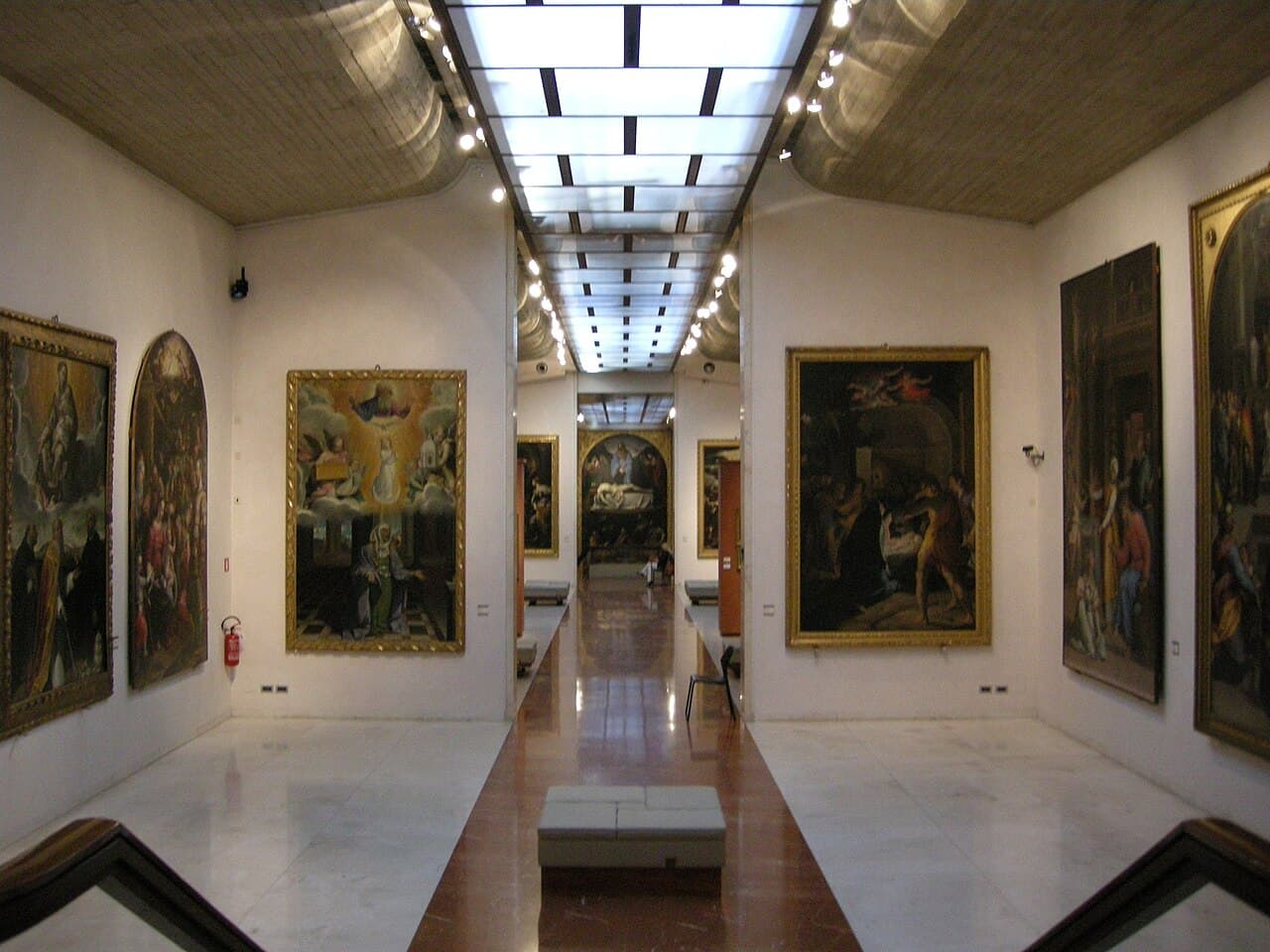
Explore the Archiginnasio, the historic seat of the University of Bologna, with its stunning anatomical theatre. Then walk a few minutes to the Pinacoteca Nazionale or MAMbo for a dose of art from Renaissance masters to contemporary Italian works.
Afternoon
Walk or take the San Luca Express tourist train to the Sanctuary of the Madonna di San Luca, connected to the city by the world's longest portico — 3,796 metres and 666 arches — with breathtaking views of Bologna and the Apennines at the summit.
Evening
Return to the city for dinner in the Santo Stefano neighbourhood. Explore the serene Basilica of Santo Stefano (a complex of medieval churches) before finding a table at one of the area's elegant local restaurants.
Day 03
Day 3 – Motor Valley Day Trip & Foodie Finale
Morning
Take a short trip into Bologna's 'Motor Valley': visit the Lamborghini Museum (Sant'Agata Bolognese) or the Ducati Museum (just outside the city) for a taste of the region's legendary automotive heritage.
Afternoon
Return to Bologna and browse the independent boutiques and artisan shops along the porticoed streets. Pick up edible souvenirs — aged Parmigiano Reggiano, authentic mortadella, or a bottle of local Sangiovese — from the market vendors.
Evening
End with a pasta-making class or a formal farewell dinner at one of Bologna's celebrated trattorias. Finish the night at a bar in the Zona Universitaria — the city's late-night social hub — for one last Bolognese spritz.
Map
Places in Bologna on a map
Places Wanderlust members have added for Bologna.
Work-ready layer
Coworking spots and laptop-friendly anchors.
Real coworking spaces, laptop-friendly cafés, and libraries mapped near the center of the city — the closest, best-rated desks first.
Spots surfaced0
Categories—
Mapped0
No coworking-ready spots surfaced for this city yet.
Map pending
No mapped workspace points yet.
Pick a different category or check back once we’ve indexed more desks for this city.
Concierge
Ask the Bologna concierge.
Share your travel style, must-see spots, or work schedule and the concierge will help turn this guide into something personal.
Personal trip brief
Tell it what kind of trip you're trying to have, and it will tighten the plan.
01
Travel style
Ask for cafés, quiet neighborhoods, date-night spots, or a first 48-hour plan.
02
Work constraints
Mention calls, Wi-Fi needs, or how much of the day has to stay laptop-friendly.
03
Real tradeoffs
Get faster answers on where to stay, when to move neighborhoods, and what to skip.
Traveler reviews
Reviews of Bologna
Written by signed-in Wanderlust members. We don't check that a reviewer has visited.
No reviews of Bologna yet.
Plan a trip to Bologna.
Tell the planner your dates, who's coming, your budget and pace, and it drafts a day-by-day itinerary you can edit.
Wanderlust Pro
Insider tips for Bologna, unlimited AI-built itineraries, and travel companions you can invite to plan a trip together. From $5.00/month, billed annually.