Top sight
Top sight
Europe's adventure capital — dramatic Alpine scenery, lake-framed thrills, and seamless Swiss rail connections.
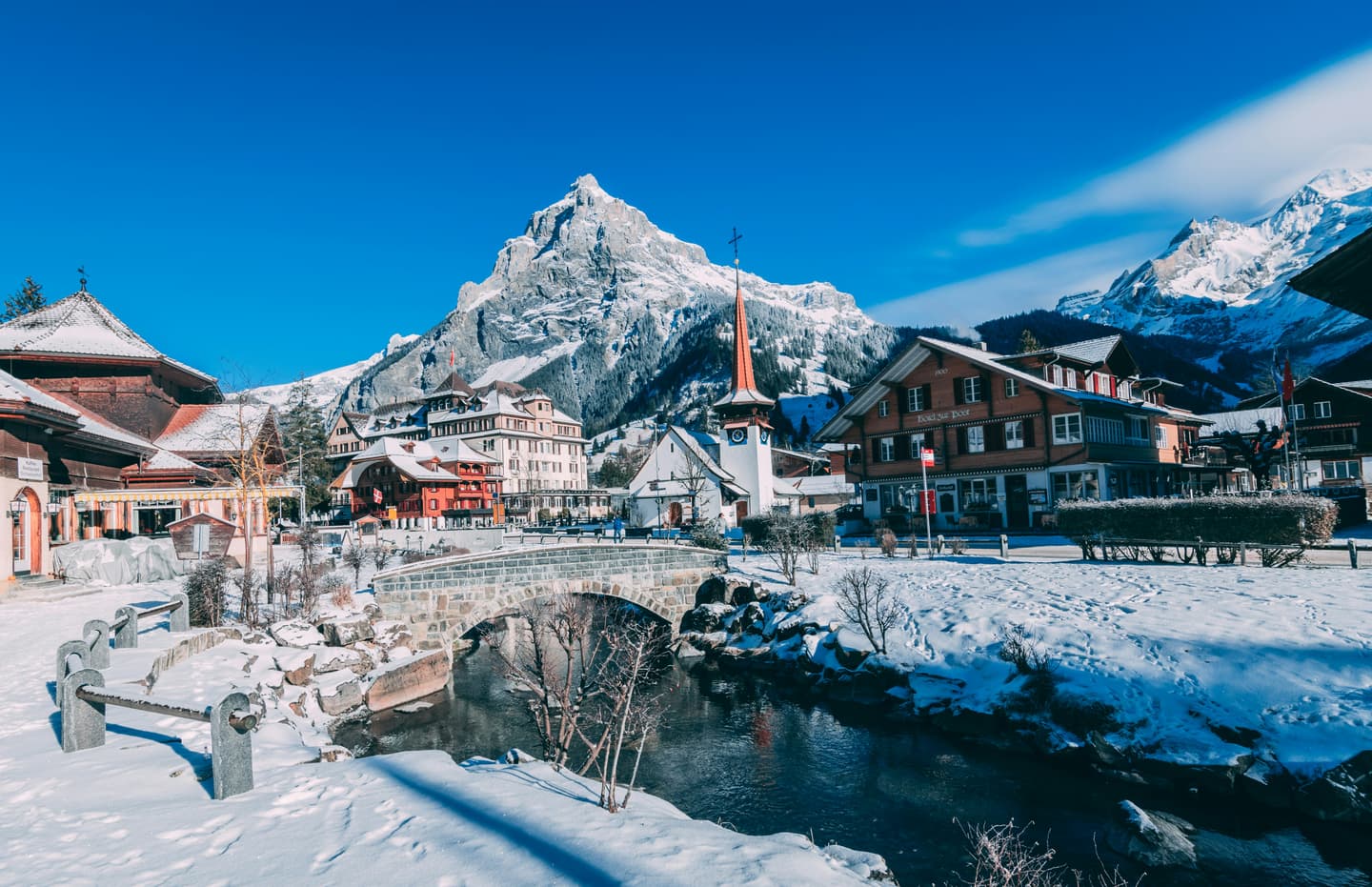
Interlaken sits between the turquoise waters of Lake Brienz and deep-blue Lake Thun, cradled by the iconic Eiger, Mönch, and Jungfrau peaks of the Bernese Oberland. The town has cemented its reputation as Europe's premier destination for adventure sports — from paragliding and canyoning in summer to skiing and night sledding in winter — while remaining effortlessly accessible via Switzerland's world-class rail network. Its compact, walkable centre blends Swiss-village charm with a cosmopolitan traveller scene, making it a natural base for exploring the wider Jungfrau region. High costs are the trade-off for pristine air, exceptional safety, and a year-round calendar of mountain experiences.
More cities for these months: Where to go in June · Where to go in July · Where to go in August · Where to go in September · Where to go in December
Insider tips · Wanderlust Pro
Practical tips on the sights and neighbourhoods in this Interlakenguide — when to go, what most visitors miss. Written with AI about the guide's own places; double-check details before you go. Pro members see every tip.
The quick answers travelers want before they commit to flights, neighborhoods, and how long to stay.
Interlaken has no commercial airport of its own. The closest is Bern Airport (BRN), roughly 45 minutes away by road or about 90 minutes by train — useful for intra-European flights. For intercontinental travellers, Zurich Airport (ZRH) is the main gateway: direct SBB trains run to Interlaken West approximately every four hours, covering the journey in around 2 hours 7 minutes (tickets typically CHF 70–210 depending on class and advance booking). Geneva Airport (GVA) is also well connected, with the journey taking approximately 2 hours 45 minutes by rail. Basel EuroAirport (BSL) is reachable in about 2 hours 20 minutes via a No. 50 bus to Basel SBB station, then a direct train onward. International coach services (e.g. FlixBus from Milan Lampugnano) also reach Interlaken Ost, with tickets from around CHF 21.50. Interlaken is well signposted from the Swiss autobahn network for those driving, though note that parking in town is limited and expensive.
Interlaken is compact and largely walkable — the 20-minute stroll along Bahnhofstrasse and Höheweg connects its two main rail hubs, Interlaken West and Interlaken Ost. The town has two train stations: West is closer to the town centre and Lake Thun; Ost is the departure point for mountain railways into the Jungfrau region (Lauterbrunnen, Grindelwald, and ultimately Jungfraujoch). Local PostAuto buses cover the town and nearby villages; hotel guests typically receive a free Interlaken Guest Card giving complimentary bus use within the immediate area. For wider exploration, three passes suit different trip lengths: the Jungfrau Travel Pass (covers Schynige Platte, First Cliff Walk, Lauterbrunnen, Harder Kulm, and lake boats; Jungfraujoch at a discount); the Berner Oberland Regional Pass; and the Swiss Travel Pass (unlimited national rail, buses, boats, 50% off most cable cars, free entry to 500+ museums). The SBB Mobile app is the essential tool — it handles multi-operator ticketing, has an EasyRide auto-fare feature, and accepts Google/Apple Pay. Bike rentals (city bike from CHF 35/day, e-mountain bike CHF 65/day) are available via RentaBike at both stations. Lake Brienz boats depart from near Interlaken Ost; Lake Thun boats leave from beside Interlaken West.
Interlaken rewards visitors year-round, but the season you choose shapes the experience entirely. Summer (June–September) is peak season: all mountain railways, cable cars, hiking trails, and lake boats are fully operational, paragliding and canyoning operators are busy, and the weather is warm enough for swimming in both lakes. July and August are the busiest months globally — book accommodation and Jungfraujoch tickets well in advance. September is a sweet spot: crowds thin, foliage begins to turn golden, and conditions for hiking remain excellent. Winter (December–March) transforms the region into a ski and snowshoe destination; nearby Grindelwald and Mürren (Schilthorn) are the main ski areas, while Interlaken itself hosts festive markets and offers night sledding. Note that Interlaken town itself has no ski runs — you'll ride the train into the mountains. Shoulder seasons (May and October) deliver fewer crowds and softer prices, but some high-altitude attractions like Schynige Platte have limited or no access due to weather, and afternoon cloud cover can obscure summit views.
Arrive into Interlaken West or Ost by train. Check in and stroll Höheweg to the Höhematte park for your first Jungfrau panorama. Explore Bahnhofstrasse and the old town of Unterseen.
Ride the funicular up to Harder Kulm (10 min from Interlaken Ost) for a bird's-eye view over both lakes and the full Eiger–Mönch–Jungfrau massif. Time a late visit for the sunset from the Panorama Restaurant.
Dine in town along Höheweg. Sample Swiss rösti and raclette at one of the local restaurants, then stroll the riverbank of the Aare.
Depart early from Interlaken Ost — take the train to Grindelwald or Lauterbrunnen, transfer to the Jungfraubahn, and ascend to the 3,454 m Jungfraujoch summit. Allow the full journey time of ~2.5 hours each way. Visit the Ice Palace and Aletsch Glacier viewpoint.
Descend back through the Jungfrau region. Stop in Grindelwald or Lauterbrunnen village to explore the waterfall valley on the way back.
Return to Interlaken for a relaxed dinner. Consider a lakeside aperitif on Lake Brienz or Lake Thun — boat tickets from Interlaken Ost to Brienz start from CHF 39.
Book a morning adventure activity: paragliding tandem flights depart from Beatenberg (from CHF 190), or try white-water rafting or canyoning with operators like Outdoor Interlaken (from CHF 120–150). Adrenaline sorted before lunch.
Take the 5-minute train from Interlaken Ost to Wilderswil, then board the historic Schynige Platte cogwheel railway (running since 1893) for sweeping views of both lakes and the alpine garden with 600+ plant species at the summit.
Return to Interlaken. Browse the Swiss chocolate boutiques and souvenir shops along Höheweg before a farewell dinner.
Real coworking spaces, laptop-friendly cafés, and libraries mapped near the center of the city — the closest, best-rated desks first.
No coworking-ready spots surfaced for this city yet.
Pick a different category or check back once we’ve indexed more desks for this city.
Ask for cafés, quiet neighborhoods, date-night spots, or a first 48-hour plan.
Mention calls, Wi-Fi needs, or how much of the day has to stay laptop-friendly.
Get faster answers on where to stay, when to move neighborhoods, and what to skip.
Written by signed-in Wanderlust members. We don't check that a reviewer has visited.
No reviews of Interlaken yet.
Tell the planner your dates, who's coming, your budget and pace, and it drafts a day-by-day itinerary you can edit.
Wanderlust Pro
Insider tips for Interlaken, unlimited AI-built itineraries, and travel companions you can invite to plan a trip together. From $5.00/month, billed annually.
Insider tips · Wanderlust Pro
Practical tips on the sights and neighbourhoods in this Interlakenguide — when to go, what most visitors miss. Written with AI about the guide's own places; double-check details before you go. Pro members see every tip.