 City postcard
Tsushima Island
Japan's untamed border island — where samurai history, primeval forest, and Korea's coastline meet on the horizon.
Japan's untamed border island — where samurai history, primeval forest, and Korea's coastline meet on the horizon.
Tsushima Island sits in the Korea Strait between Kyushu and the Korean Peninsula, closer to Busan than to Fukuoka, making it one of Japan's most geopolitically unique destinations. Covering 709 square kilometres with 89% of its land blanketed in primeval forest, it is the largest island in Nagasaki Prefecture and the setting that inspired the hit video game Ghost of Tsushima. Visitors come for ancient castle ruins, floating torii gates, the endangered Tsushima leopard cat, and a slow island rhythm largely unchanged by mass tourism.
City postcardJapan's untamed border island — where samurai history, primeval forest, and Korea's coastline meet on the horizon.
A signature stop locals and returning travelers point to in Tsushima Island.
A signature stop locals and returning travelers point to in Tsushima Island.
A signature stop locals and returning travelers point to in Tsushima Island.
A signature stop locals and returning travelers point to in Tsushima Island.
A signature stop locals and returning travelers point to in Tsushima Island.
A signature stop locals and returning travelers point to in Tsushima Island.
A signature stop locals and returning travelers point to in Tsushima Island.
A signature stop locals and returning travelers point to in Tsushima Island.
A pocket of Tsushima Island with its own temperament — worth a deliberate detour when you're in the area.
A pocket of Tsushima Island with its own temperament — worth a deliberate detour when you're in the area.
A pocket of Tsushima Island with its own temperament — worth a deliberate detour when you're in the area.
A pocket of Tsushima Island with its own temperament — worth a deliberate detour when you're in the area.
Wanderlust Pro
Pro members see insider tips for Tsushima Island: a short list of restaurants, cafés and sights, picked by AI as local suggestions to double-check before you go.
The quick answers travelers want before they commit to flights, neighborhoods, and how long to stay.
**By air:** The fastest way in is Tsushima Yamaneko Airport (TSJ), a tiny single-gate airport on the island's north side. ANA operates up to 3 daily flights from Fukuoka Airport (FUK) in approximately 30 minutes; Oriental Air Bridge (ORC) connects Nagasaki Airport in about 35 minutes. Book via ANA or ORC websites — seats sell out on weekends and Golden Week.
**By high-speed jetfoil (from Fukuoka):** Kyushu Yusen runs a jetfoil from Hakata Ferry Terminal to Izuhara Port in approximately 2 hours 15 minutes, costing around ¥6,330 (~US$44) one-way. This is the most popular sea option.
**By car ferry (from Fukuoka):** Kyushu Yusen and Iki-Tsushima Ferry operate car ferries from Hakata Port; the journey to Izuhara takes approximately 4 hours 30–45 minutes. Night ferries are available, saving hotel costs. The ferry is the cheapest sea option and the only way to bring a vehicle.
**From South Korea (Busan):** Panstar Tsushima Link runs a hydrofoil from Busan to Hitakatsu Port in approximately 90 minutes — the shortest crossing to the island. Note: the JR Beetle service permanently ceased operating in December 2024.
**Getting to Hakata Port from Fukuoka Airport:** Take the subway 5 minutes to Hakata Station, then Bus No. 99 to the last stop (do not board the International Terminal bus).
**Rent a car — it is essential.** Tsushima spans 82 km north to south, and driving from Hitakatsu Port to Izuhara Port takes over 2 hours. Public bus routes are limited and do not reach most tourist attractions. Foreign visitors need a valid International Driving Permit (IDP) to rent a car; book in advance as availability is limited on the island.
**Buses:** Limited routes traverse the island and one-day discount bus passes are available for tourists, but they cover only the main corridors. Suitable only for staying close to Izuhara.
**Taxis:** Available but expensive over long distances given the island's size — best reserved for short town-to-port transfers.
**Bicycles:** Possible for shorter sightseeing loops around Izuhara; some rental shops near the port offer bicycle hire.
**Tip:** Fill up on fuel in Izuhara or Hitakatsu — petrol stations in between can be sparse.
**Spring (April–May)** is the sweet spot: cherry blossoms dot the island's forests, temperatures are mild, humidity is low, and the coastal views are crystal clear. Avoid late April–early May Golden Week, when domestic tourists flood the island and ferry/hotel prices spike.
**Autumn (September–October)** rivals spring for hiking and sightseeing — the forests turn russet and the skies are reliably clear, allowing views all the way to the Korean coastline from the peaks. November is a pleasant shoulder month with reasonable prices.
**Summer (June–August)** is beach season: Miuda Beach (one of Japan's top 100 beaches) is at its best, and kayaking on Aso Bay is superb. However, summer is also peak season — accommodation doubles in price in August around the Obon festival, and humidity is high.
**Winter (January–February)** is cheapest and quietest, with some attractions reducing hours, but it is a good season for birdwatching as migratory cranes pass through, and on clear days the snow-dusted Korean mountains are visible from Mt. Shiratake's summit.
Arrive by jetfoil or morning flight into Izuhara Port. Pick up your rental car and head straight to Kaneda Castle Ruins on Mt. Joyama — a 7th-century Korean-style mountain fortress with panoramic views of Aso Bay. The 2.6 km trail to the summit takes about 50 minutes up.
Descend into Izuhara's well-preserved old town. Visit Banshoin Temple, the 1615 family temple of the Tsushima Domain lords, climbing the 100-step stone staircase past centuries-old mausoleums. Explore the Tsushima History & Folk Museum nearby.
Stroll Izuhara Port's historic harbour streets. Dine on local specialities — anago (saltwater eel) or rokube noodles made from sweet-potato starch — at one of the port-side restaurants. Overnight in Izuhara.
Drive north from Izuhara (approx. 1 hour) to the Eboshidake Observatory for a sweeping panorama of Aso Bay's ria coast — a maze of islands and inlets often described as a living painting. On a clear day you can see the outlines of the Korean Peninsula.
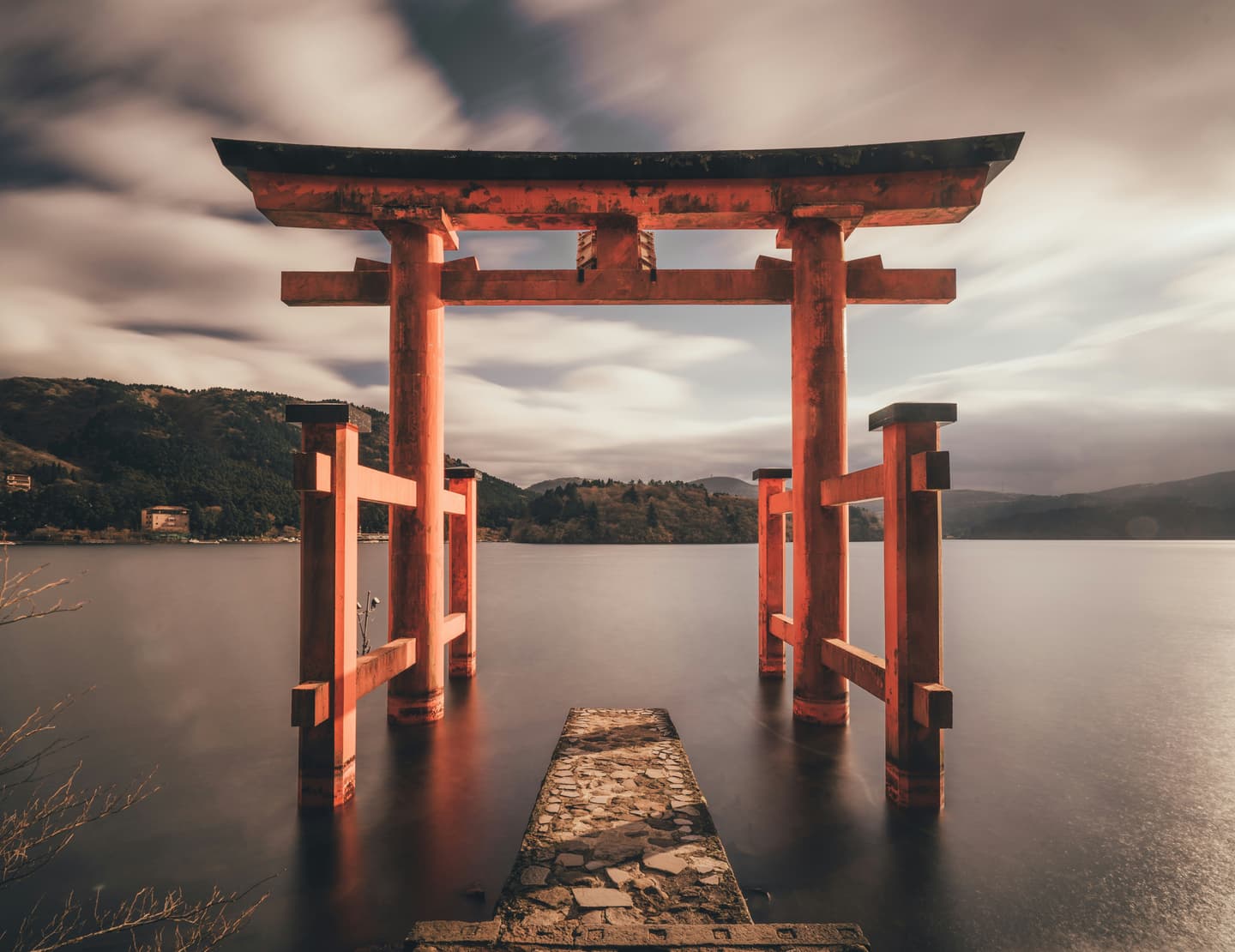
Continue to the Tsushima Wildlife Conservation Center in Saozaki Park to see the critically endangered Tsushima leopard cat up close. The centre runs conservation exhibits (mostly in Japanese — use Google Translate). Nearby, stop at Watatsumi Shrine, whose iconic three-legged torii stands in the calm bay — one of the island's most photogenic spots.
Head to Mitsushima for a relaxed evening. Check into a ryokan or guesthouse with sea views. Try Taishu soba — buckwheat noodles said to have been introduced to Japan through Tsushima over 2,500 years ago.
Drive to Miuda Beach in the far north — one of Japan's top 100 beaches, with white sand and emerald water. Swim in summer or simply explore the unspoilt coastline. The beach has camping facilities and equipment rental during peak season.
Continue to Komoda Beach and the Komodahama Shrine, site of the 1274 Mongol invasion landing. The shrine memorialises Tsushima's samurai defenders. On a clear day, climb any coastal headland for a view toward Busan — just 49.5 km away. Fuel up and head toward Hitakatsu Port.
If departing by hydrofoil to Busan or by Iki-Tsushima ferry, catch the late departure from Hitakatsu Port. Alternatively, stay a final night in Hitakatsu and fly out from Yamaneko Airport the next morning.
Real coworking spaces, laptop-friendly cafés, and libraries mapped near the center of the city — the closest, best-rated desks first.
No coworking-ready spots surfaced for this city yet.
Pick a different category or check back once we’ve indexed more desks for this city.
Ask for cafés, quiet neighborhoods, date-night spots, or a first 48-hour plan.
Mention calls, Wi-Fi needs, or how much of the day has to stay laptop-friendly.
Get faster answers on where to stay, when to move neighborhoods, and what to skip.
There aren’t any, yet!
Block off the weeks you're free. Wanderlust turns this dossier — flights, lodging, neighborhoods, timing — into a single draft itinerary in about ninety seconds.
Wanderlust Pro
Insider tips for Tsushima Island, unlimited AI-built itineraries, and travel companions you can invite to plan a trip together. From $5.00/month, billed annually.
Wanderlust Pro
Pro members see insider tips for Tsushima Island: a short list of restaurants, cafés and sights, picked by AI as local suggestions to double-check before you go.